
A Glance at Light and Shadow
What is remembering? What do we remember? What function does the mind serve here? And how do we classify time?
We call learning indirectly or by experience—and remembering these—experience.
The brain is a marvelous organ, with a background working mechanism that performs great mathematical functions without you needing to think. You can chew gum while walking, or focus on your daily tasks.
Walking! Such a simple act. Muscle memory that occurs every day without us noticing. While scientists in robotics try to calculate equations to make a single step happen—balance, obstacles, and continuity of movement—the brain accomplishes this without disturbing its owner at all. It calculates pits and threats. Even if you stumble from time to time, throughout your entire life you have flawlessly avoided risks without realizing it. You continued on your path and you thought, planned your daily tasks, finished your shopping…
Drawing the shape we want in the place we want with a pen. Carrying food to our mouth with a fork. Combing your hair… we underestimate the thousands of functions happening in the background. Human beings possess a mechanism capable of performing all this wonderfully. We can think, focus on tasks that need to be done, and prepare for the next challenge. Still, most of us struggle to multiply two three-digit numbers or recall a book we read five years ago. Rarely, some brilliant minds stand out in this regard; we call this high intelligence, or depending on the situation, below-threshold intelligence.
What is your reference point on the timeline? Your birth? Considering an important event as a turning point? A mass event? The existence of humanity? In every person’s life, some things occurred before that reference, others after. We want to position ourselves in time. Just like locating your address, the place you live, and getting rid of that feeling of being lost.
On March 11, 2011, at 14:46 Japan time, an earthquake with a magnitude of 9 occurred and lasted a very long time. It was the largest earthquake in Japan's history and one of the five largest recorded earthquakes in the world. More than twenty thousand people died or went missing. One hundred twenty thousand buildings were completely destroyed. Tsunami waves averaging ten meters that struck residential areas were recorded.
The Pacific coasts, home to hundreds of people, animals, and plants, were greatly affected by this earthquake. Losses occurred that would take years to repair. Naturally, scientific studies began after the process. The effects of the earthquake were recorded. And these studies brought a truth to light: the Japanese milestone stones. It was determined that these stones dated between three hundred and six hundred years ago, and they renewed the collective memory.
On stones placed in Japan centuries ago, it briefly said: do not build your homes below this line. The indicated points marked the highest points reached by the tsunami. People in the region who experienced major earthquakes in 1771 or 1896 placed them to create a shared awareness to be passed on to future generations, to protect life.
Before three hundred years passed, a similar disaster affecting thousands of people occurred again. Today, these stones are a known fact in Japanese culture.
The average human lifespan is accepted as seventy-three years in 2025; this number is a world average. In 1900, because infant mortality was so high, it was thirty-one. In the past century, we managed to increase this number more than twice thanks to scientific development.
Three hundred years equals five to seven generations. In a society like Japan, attached to its culture and roots, this disaster was forgotten over this period. People, for example a fishing community, moved their homes again below the forgotten line and remembered painfully again in 2011.
In the light of scientific data, modern humans—our ancestors—have existed on Earth for approximately two hundred to four hundred thousand years, and the last mass extinction is dated to seventy thousand years ago. The very few humans who remained on Earth multiplied, spread, and sustained humanity, and in this process, we built civilization.
Let’s return to the question we asked at the beginning: what do we remember in this process? Why is a disaster that occurred three hundred years ago forgotten after a few generations? Why do we celebrate the discovery of Gobekli Tepe with great triumphs? Why do we have no idea about things that happened thirty thousand years ago? Think of the Second World War and the great destruction caused by humans; in our present, racist and self-centered thinking is rising again.
What about what we have achieved unknowingly? Looking at the environment we live in, from small to large, the survival of a human being is a miracle, yet here we are—alive, with goals, working for more, and very determined. The body we have is capable and sufficient to accomplish great things.
The human brain, which achieves great things, usually ignores the shared legacy. We may disregard the signs nature shows us. Sometimes we cannot even feel our instincts.
While time passes, think about what you overlook—perhaps what you lack in life is one of these. A small packet of knowledge—something you actually possess but overlook, and if you could see it, it would take you further.
A human stands balanced on the fine line between power and helplessness; the closer you get to power, the thinner the line becomes. Being aware does not have to be the line between life and death; sometimes it separates success and failure, loneliness and friendship, hope and hopelessness.
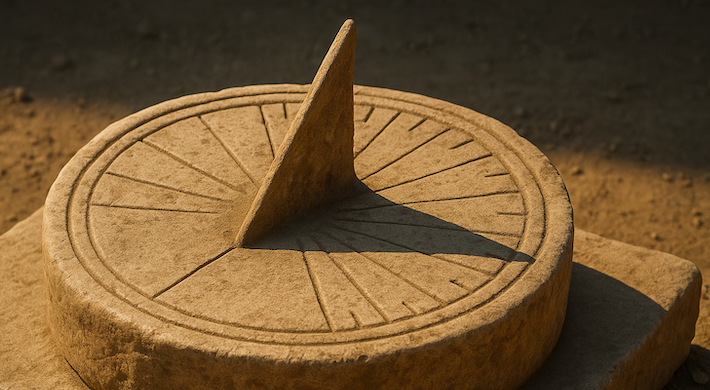
We associate time with shadows; the light and shadow clock is the first time-measuring method developed by humans. The shadow you see at the moment disappears a moment later. Knowledge in the human mind is the same, isn’t it? Shadows passing with tiny sparkles.
Stay in the moment.